
Make biogas in your backyard from food and poop

Energy from food scraps and other biomass? A lot has been written about converting biomass into fuel, including using poultry poop as an energy source.  The idea of using food scraps as a biofuel for cars has even been touted as a futuristic idea in such Hollywood movies as Back to the Future, when Marty McFly’s professor friend throws banana peels and other food scraps into the fuel intake of his futuristic Delorean DMC-12 flying car. 

In reality, the above sci-fi prediction,  as shown in the movie, has yet to take place. Even with this in mind, creating bio-fuel in the form of cooking gas is now possible using food scraps, animal wastes and even human poop. A portable device which does this conversion  is now being marketed by an Israel based company HOMEBIOGAS 

HOMEBIOGAS displayed its portable biomass converter at a recent Cleantech exposition and seminar in Tel Aviv. The device converts food waste like fruit and veggie scraps meat scraps and other organic material into safe and usable bio-gas in a process similar to producing compost fertilizer for your garden. The device, called the BioGas, simply breaks down the composition of food and other organic waste products in 4 easy steps:

1. Food waste is fed into the device’s “fuel” intake tube (shades of the professor’s Delorean).
2. Biomass consuming bacteria placed in the device, or appliance, breaks down the organic waste in an internal “digester”.
3. The biomass breakdown process creates methane bio-gas that is stored in a special gas holding bag on top of the appliance.
4. The created bio-gas then flows into a gas stove or burner for home use.

A “spinoff” by-product of this procedure is a high quality liquid fertilizer that has a variety of uses in home gardens, lawns and the like.

The portable Biogas appliance sells for around $500 and is now being marketed in more than 92 countries. The device’s “digester tank” holds up; to 1,200 liters of organic material and the bio-gas holding tank holds up to 700 liters of converted bio fuel.

The model on display even had a portable toilet attached to it, similar to one used in boats and campers. “It is possible to use human waste, including toilet paper, for making biogas” says one of the company’s marketing representatives, Oriya Barkai, Regional sales Manager (see photo}. who was present at the Cleantech fair.
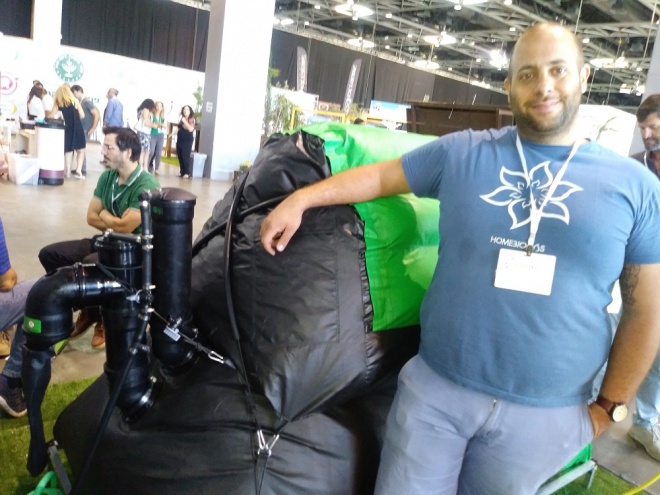
Barkai says that a safety feature of the appliance is that the pressure of the bio-gas in the holding tank is much less than accumulated gas a conventional propane or LP gas tank. Being made almost entirely out of PVC type plastic materials and perhaps subject to leakage or rupture could be a possible fire hazard, however.

Read more on biomass composting and biomass energy:

Poultry poop could be a remarkable energy source

The Urban Death Project will turn your dead body into beetroot

Algae returns as fuel for our future

Maurice Picow
Maurice Picowhttps://www.greenprophet.com/
Maurice Picow grew up in Oklahoma City, U.S.A., where he received a B.S. Degree in Business Administration. Following graduation, Maurice embarked on a career as a real estate broker before making the decision to move to Israel. After arriving in Israel, he came involved in the insurance agency business and later in the moving and international relocation fields. Maurice became interested in writing news and commentary articles in the late 1990’s, and now writes feature articles for the The Jerusalem Post as well as being a regular contributor to Green Prophet. He has also written a non-fiction study on Islam, a two volume adventure novel, and is completing a romance novel about a forbidden love affair. Writing topics of particular interest for Green Prophet are those dealing with global warming and climate change, as well as clean technology - particularly electric cars.

Hot this week

How Renewable Energy is Revolutionizing the Way We Power Our World

Solar has become the star of the transition thanks to modular hardware and straightforward installation. It fits dense cities and remote towns alike. Many companies are turning to rooftop arrays and carport systems - and exploring commercial solar installation as a practical way to lock in future savings.

How does one start prepping?

Faced with an extreme winter storm this year, Americans wonder how to be prepared for catastrophe. Miriam has lived through wars in the Middle East - so she's prepared on giving you a guide to prepping.

Fishermen sue tire manufacturers on behalf of the salmon

A federal trial in San Francisco has brought US tire manufacturers, fishing groups, and environmental scientists into court over a chemical most drivers have never heard of — but which scientists say may be silently reshaping aquatic ecosystems.

Listening to Water: Tarek Atoui’s Next Work for Tate Modern

Born in Beirut, Lebanon in 1980 and now living in Paris, Atoui has spent years building instruments that don’t sit comfortably in concert halls. Many of them involve water, glass, and ceramics — materials that react to sound instead of simply producing it.

Leading Through a Dual-Energy Transition: Balancing Decarbonisation with Energy Security

Experience in one area of the energy industry isn't enough to guarantee readiness across all the others. That's where a structured program like an MBA in energy can come in. Today's advanced curricula explore energy economics, finance, policy, and strategic management alongside the technical subjects. And when pursuing an energy MBA online, professionals can skill up and retrain without having to step out of the labor market -- an important perk at a time when skilled professionals are already in short supply.

Topics

How Renewable Energy is Revolutionizing the Way We Power Our World

Solar has become the star of the transition thanks to modular hardware and straightforward installation. It fits dense cities and remote towns alike. Many companies are turning to rooftop arrays and carport systems - and exploring commercial solar installation as a practical way to lock in future savings.

How does one start prepping?

Faced with an extreme winter storm this year, Americans wonder how to be prepared for catastrophe. Miriam has lived through wars in the Middle East - so she's prepared on giving you a guide to prepping.

Fishermen sue tire manufacturers on behalf of the salmon

A federal trial in San Francisco has brought US tire manufacturers, fishing groups, and environmental scientists into court over a chemical most drivers have never heard of — but which scientists say may be silently reshaping aquatic ecosystems.

Listening to Water: Tarek Atoui’s Next Work for Tate Modern

Born in Beirut, Lebanon in 1980 and now living in Paris, Atoui has spent years building instruments that don’t sit comfortably in concert halls. Many of them involve water, glass, and ceramics — materials that react to sound instead of simply producing it.

Leading Through a Dual-Energy Transition: Balancing Decarbonisation with Energy Security

Experience in one area of the energy industry isn't enough to guarantee readiness across all the others. That's where a structured program like an MBA in energy can come in. Today's advanced curricula explore energy economics, finance, policy, and strategic management alongside the technical subjects. And when pursuing an energy MBA online, professionals can skill up and retrain without having to step out of the labor market -- an important perk at a time when skilled professionals are already in short supply.

From Green Energy to Healthy Societies: Why old systems thinking is becoming relevant again

Across the Middle East and North Africa, large investments are being made in green hydrogen, renewable energy, water infrastructure and sustainability. Most of these efforts are discussed in the context of climate change, decarbonization and economic diversification. That framing is important, but it may not capture their full value.

We saw peace – an interreligious encounter deep in our eyes

They came from Israel, Palestine, Jordan, Iraq, Yemen, Morocco, Tunisia, Lebanon, Egypt… There are Sunni Muslims, Shiite Muslims, Jews (Orthodox and Reform), Orthodox Christians, Coptic Christians, Protestant Christians, Druze, Baha'is, a Scientologist.

Can biochar reduce ‘Forever Chemicals’ in food if it’s used in farms?

Biochar is produced by heating organic material in a low-oxygen environment so it does not burn. This process, known as pyrolysis, transforms plant matter into a stable, carbon-rich material.

Related Articles

Popular Categories